What you get
Designed to look bought, priced at nothing
Three print sizes
A2 and A3 for home printers, plus 18×24" for a print shop or easel.
Fully editable
Change the wording in any free PDF editor — no design software needed.
High-resolution
Crisp 300 DPI vector text that stays sharp at poster size.
How to use it
From download to display in three steps
- Personalise. Open the PDF in Canva, Acrobat online or Apple Preview and edit the text.
- Print. Heavyweight matte card at home for A3 and under; a print shop for 18×24".
- Display. Frame it or stand it on an easel at your .
Top picks compared
| Pick | What you'll want | Best for | |
|---|---|---|---|
| Top pick | A4 heavyweight matte card | Cornell notes | Check price → |
| Notebook | Academic notebook A4 lined study notes hardback | Take notes | Check price → |
| Highlighters | Highlighters pastel set study revision pens | Highlight | Check price → |
As an Amazon Associate we earn from qualifying purchases. Prices shown on Amazon at time of click.
Frequently asked questions
What is the Cornell note-taking method and why use it?
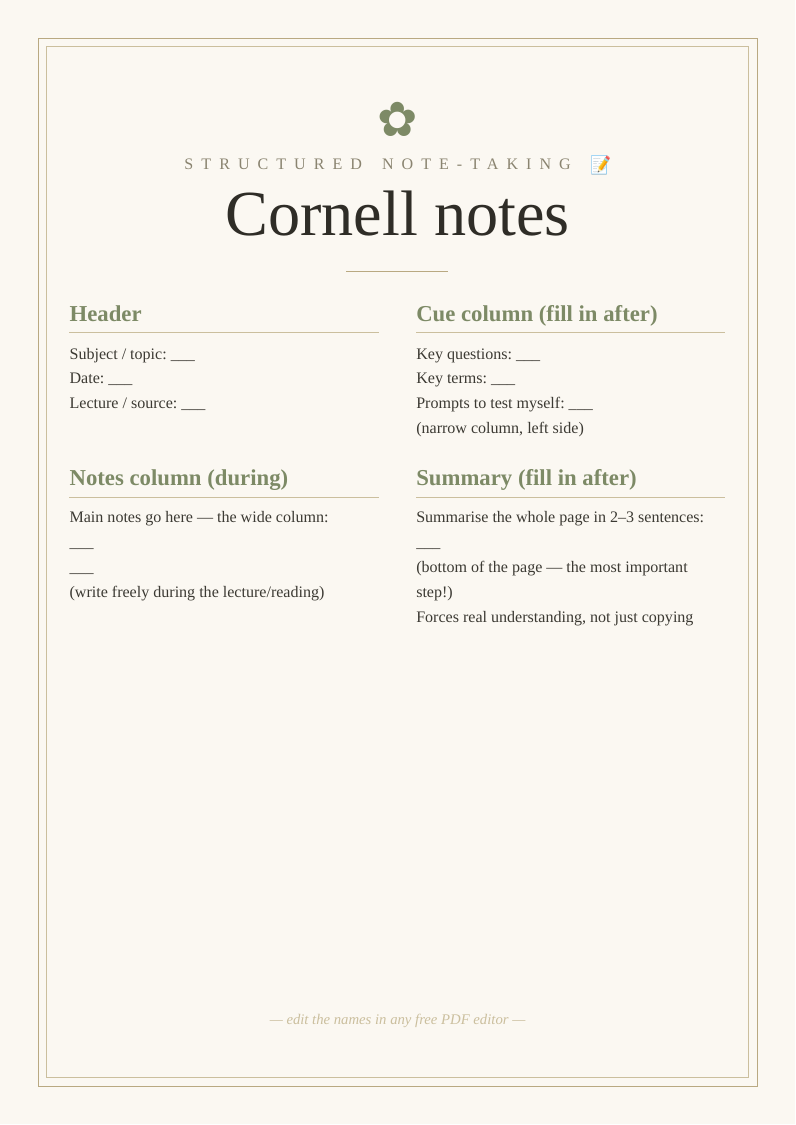
The Cornell method is a structured way of taking notes, developed at Cornell University, that splits a page into three sections: a wide main notes column for writing during a lecture or while reading, a narrower 'cue' column on the side filled in afterwards with key questions, terms or prompts that relate to the notes, and a summary section at the bottom where you condense the entire page into two or three sentences. It works better than plain note-taking for several reasons. The cue column, filled in after the fact rather than during, forces you to actively process and organise what you've just learned rather than just writing it down and moving on — and it doubles as a brilliant revision tool later, since you can cover the main notes and use just the cues to test yourself (a form of active recall). The summary section is arguably the most valuable part and the one people most often skip: forcing yourself to distil a whole page of notes into a couple of sentences requires genuine understanding, not just transcription, and quickly reveals whether you've actually grasped the material or just copied it down. The structure also makes notes far more useful when you come back to revise weeks or months later, since the cue column and summary give you an instant overview without having to re-read everything in detail. It takes a small amount of extra discipline compared to free-form notes, but the payoff in both understanding and revision efficiency is well worth it for lectures, reading, and any substantial material you'll need to actually remember and use later, not just write down once.
Is it really free?
Yes — no email, no sign-up.
Can I print it more than once?
Yes — print as many copies as you need.