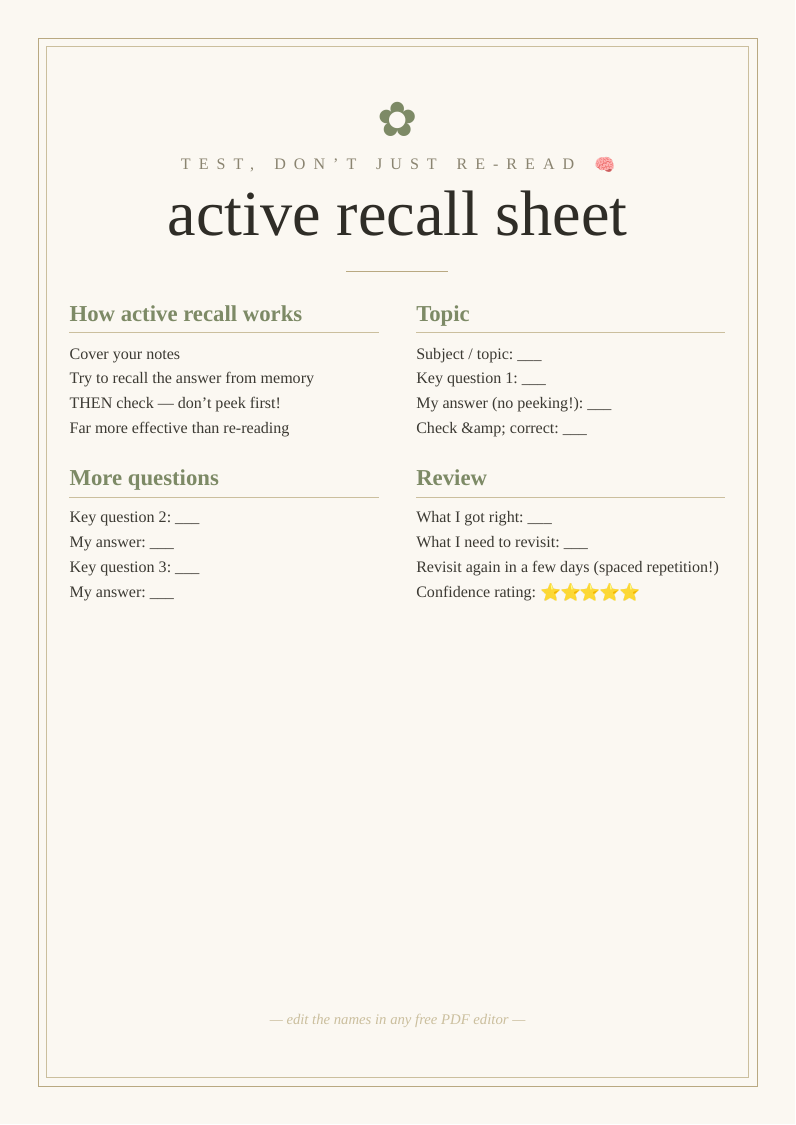
What you get
Designed to look bought, priced at nothing
Three print sizes
A2 and A3 for home printers, plus 18×24" for a print shop or easel.
Fully editable
Change the wording in any free PDF editor — no design software needed.
High-resolution
Crisp 300 DPI vector text that stays sharp at poster size.
How to use it
From download to display in three steps
- Personalise. Open the PDF in Canva, Acrobat online or Apple Preview and edit the text.
- Print. Heavyweight matte card at home for A3 and under; a print shop for 18×24".
- Display. Frame it or stand it on an easel at your .
Top picks compared
| Pick | What you'll want | Best for | |
|---|---|---|---|
| Top pick | A4 heavyweight matte card | Recall sheet | Check price → |
| Flashcards | Blank flashcards revision cards index cards pack | Test recall | Check price → |
| Study book | How to study book revision techniques students UK | Learn more | Check price → |
As an Amazon Associate we earn from qualifying purchases. Prices shown on Amazon at time of click.
Frequently asked questions
What is active recall and why does it work?
Active recall is a revision technique where, instead of passively re-reading notes or highlighting text, you actively test yourself on the material — covering your notes and trying to remember the answer before checking. It's one of the most well-evidenced study techniques there is, consistently shown in educational psychology research to build far stronger, longer-lasting memory than passive methods like re-reading or highlighting, which feel productive but create only a shallow, temporary sense of familiarity rather than genuine recall ability. The reason it works is that the effort of retrieving information from memory — even when you get it wrong at first — strengthens the neural pathways to that information far more than simply seeing it again. To use active recall: turn your notes into questions, cover the answers, genuinely try to recall them from memory (resist the urge to peek), then check and correct yourself. Flashcards are a classic active recall tool, but you can do it with any notes by covering sections and quizzing yourself, or using practice questions. It works even better combined with spaced repetition — revisiting the same material at increasing intervals over days and weeks, rather than cramming once. It can feel harder and slower than re-reading, precisely because it's doing real cognitive work, but that difficulty is exactly what makes it effective. Switching from re-reading to active recall is one of the single highest-impact changes a student can make to how they revise.
Is it really free?
Yes — no email, no sign-up.
Can I print it more than once?
Yes — print as many copies as you need.