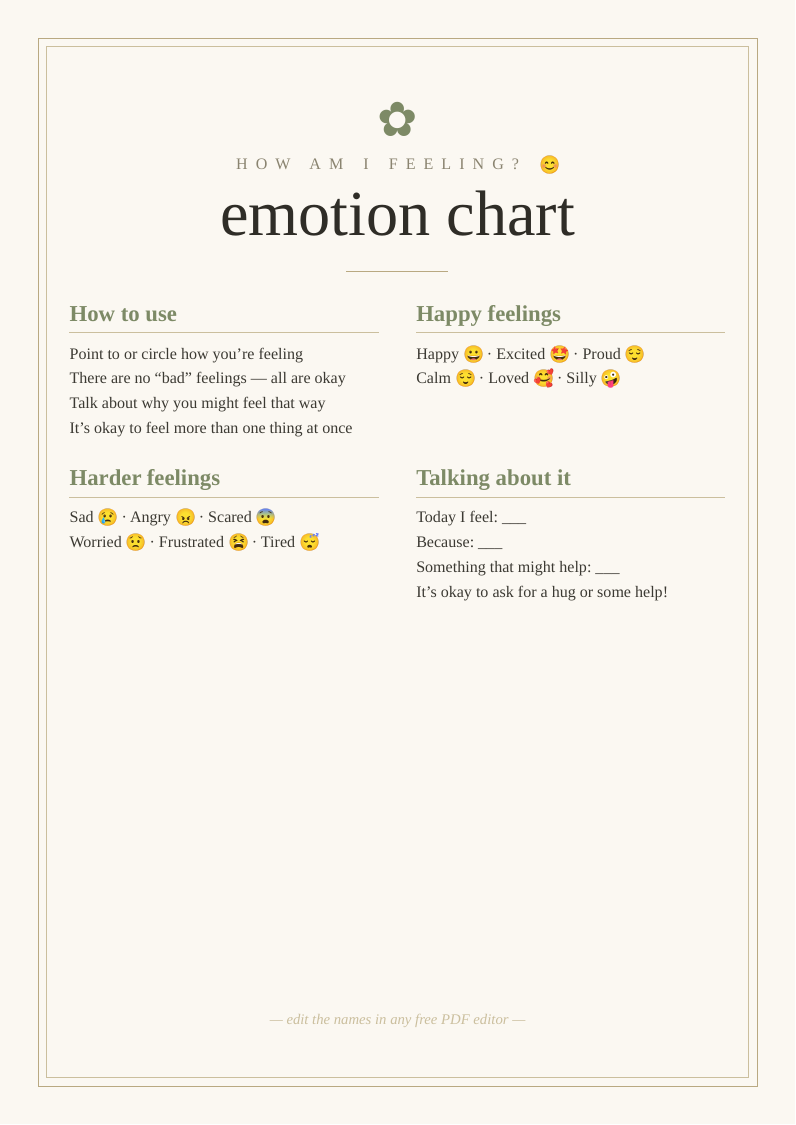
What you get
Designed to look bought, priced at nothing
Three print sizes
A2 and A3 for home printers, plus 18×24" for a print shop or easel.
Fully editable
Change the wording in any free PDF editor — no design software needed.
High-resolution
Crisp 300 DPI vector text that stays sharp at poster size.
How to use it
From download to display in three steps
- Personalise. Open the PDF in Canva, Acrobat online or Apple Preview and edit the text.
- Print. Heavyweight matte card at home for A3 and under; a print shop for 18×24".
- Display. Frame it or stand it on an easel at your .
Top picks compared
| Pick | What you'll want | Best for | |
|---|---|---|---|
| Top pick | A4 heavyweight matte card | Emotion chart | Check price → |
| Feelings book | Childrens feelings book emotions story age appropriate | Read together | Check price → |
| Laminate | A4 laminator pouches self laminating waterproof | Laminate it | Check price → |
As an Amazon Associate we earn from qualifying purchases. Prices shown on Amazon at time of click.
Frequently asked questions
How does an emotion chart help children?
An emotion (or feelings) chart is a simple, widely-used tool that helps children build emotional vocabulary and self-awareness, which are foundational skills for managing feelings well, both in childhood and into later life. Young children often experience strong emotions without yet having the words to identify or express what they're feeling, which can be confusing and frustrating both for the child and for the adults trying to support them — a visual chart with clear faces or expressions alongside simple feeling words gives children a concrete way to point to or name what's going on internally, even when they can't yet fully articulate it in their own words. This matters because naming an emotion is generally considered an important first step in managing it; psychologists sometimes describe this as 'name it to tame it', the idea that simply identifying and labelling a feeling can help reduce its intensity and give a child (or adult) a sense of having some understanding and even a little control over what they're experiencing, rather than just being overwhelmed by it. A good chart includes a range of emotions, not just the simple 'happy/sad', and importantly frames all feelings as acceptable and normal to have, including the harder ones like anger, worry or frustration, which helps children understand that experiencing difficult emotions isn't 'bad' or something to be ashamed of, simply part of being human. Using the chart regularly, in calm moments as well as harder ones, and talking through it together rather than just handing it over, helps children build the habit of checking in with and naming their feelings, and gives parents and teachers a gentle, low-pressure way to open conversations about emotional wellbeing. It's a simple tool, but one that supports a skill children will keep building on throughout their lives.
Is it really free?
Yes — no email, no sign-up.
Can I print it more than once?
Yes — print as many copies as you need.