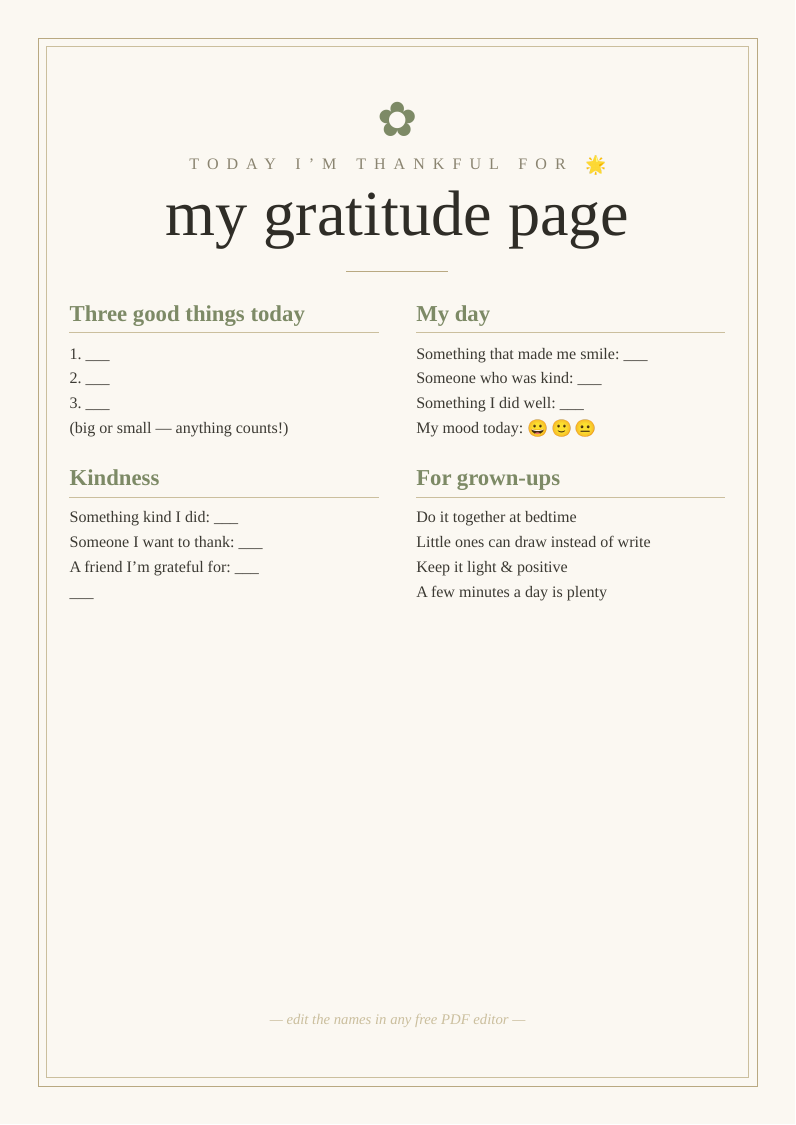
What you get
Designed to look bought, priced at nothing
Three print sizes
A2 and A3 for home printers, plus 18×24" for a print shop or easel.
Fully editable
Change the wording in any free PDF editor — no design software needed.
High-resolution
Crisp 300 DPI vector text that stays sharp at poster size.
How to use it
From download to display in three steps
- Personalise. Open the PDF in Canva, Acrobat online or Apple Preview and edit the text.
- Print. Heavyweight matte card at home for A3 and under; a print shop for 18×24".
- Display. Frame it or stand it on an easel at your .
Top picks compared
| Pick | What you'll want | Best for | |
|---|---|---|---|
| Top pick | A4 heavyweight matte card | Gratitude page | Check price → |
| Journal | Childrens gratitude journal kids wellbeing daily prompts | A journal | Check price → |
| Pens | Colouring pens felt tips children washable bright set | Write & draw | Check price → |
As an Amazon Associate we earn from qualifying purchases. Prices shown on Amazon at time of click.
Frequently asked questions
Is gratitude journalling good for children?
Helping children notice and name the good things in their day is a gentle, positive habit that can support their wellbeing and nurture an optimistic outlook over time. A simple gratitude page — three good things, something that made them smile, someone who was kind — gives them an easy, structured way to reflect, and doing it together (often at bedtime) makes it a warm shared moment and a chance to talk about their day. Keep it light and pressure-free: younger children can draw their answers instead of writing, anything counts (big or small), and a few minutes is plenty. The aim isn't to force positivity or dismiss difficult feelings — children should always feel able to share when something's wrong too — but simply to build the habit of noticing the good alongside the hard. If a child seems persistently low or anxious, it's worth talking to your GP or their school.
Is it really free?
Yes — no email, no sign-up.
Can I print it more than once?
Yes — print as many copies as you need.