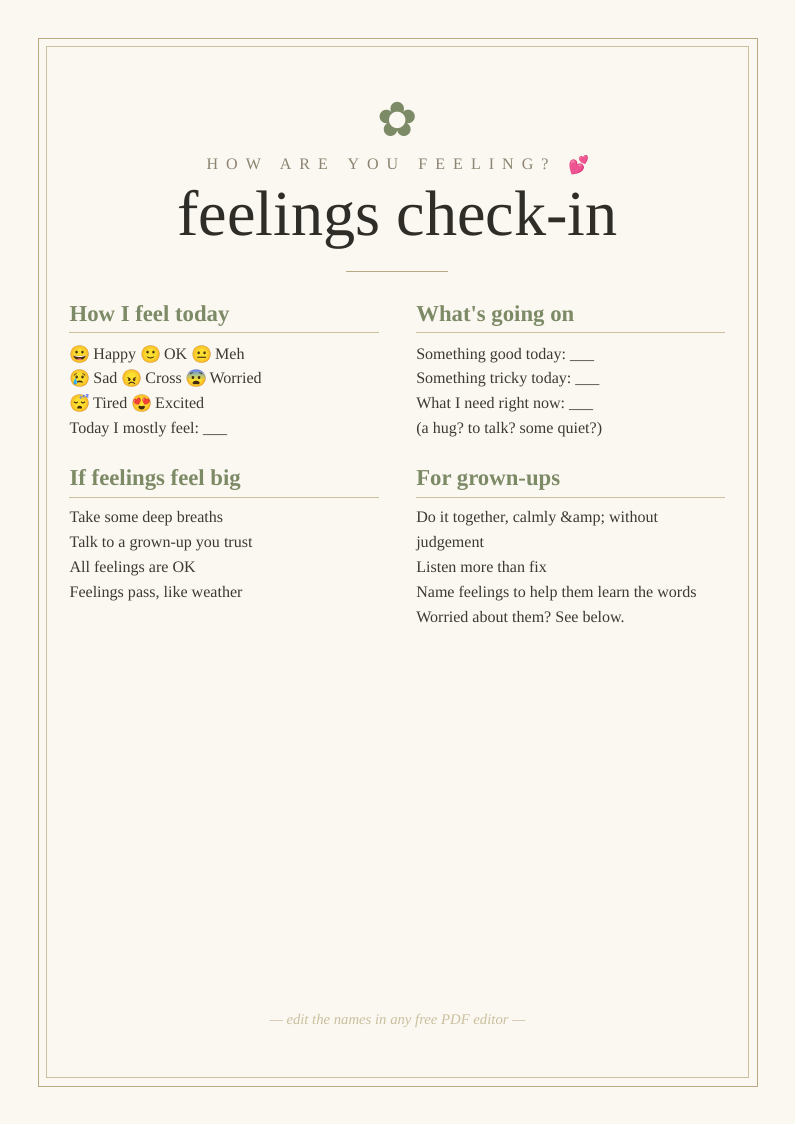
What you get
Designed to look bought, priced at nothing
Three print sizes
A2 and A3 for home printers, plus 18×24" for a print shop or easel.
Fully editable
Change the wording in any free PDF editor — no design software needed.
High-resolution
Crisp 300 DPI vector text that stays sharp at poster size.
How to use it
From download to display in three steps
- Personalise. Open the PDF in Canva, Acrobat online or Apple Preview and edit the text.
- Print. Heavyweight matte card at home for A3 and under; a print shop for 18×24".
- Display. Frame it or stand it on an easel at your .
Top picks compared
| Pick | What you'll want | Best for | |
|---|---|---|---|
| Top pick | A4 heavyweight matte card | Feelings chart | Check price → |
| Feelings cards | Childrens emotions feelings cards talking therapy kids | Name feelings | Check price → |
| Book | Childrens book about feelings emotions big feelings kids | Read together | Check price → |
As an Amazon Associate we earn from qualifying purchases. Prices shown on Amazon at time of click.
Frequently asked questions
How can you help children talk about their feelings?
Helping children recognise and name their emotions is one of the most valuable things you can do for their wellbeing, and it starts with giving them the words. A simple feelings check-in — pointing to how they feel and saying it out loud — builds that emotional vocabulary and normalises talking about feelings as an everyday thing, not just something for when there's a problem. A few principles help: make it a calm, judgement-free moment, reassure them that all feelings are OK (it's what we do with them that matters), and listen more than you rush to fix — sometimes children just need to feel heard. Naming the feeling yourself ('it sounds like you felt really left out') helps them learn the language. Doing a check-in regularly, even briefly, keeps the door open for the bigger conversations. If a child seems persistently low, anxious or withdrawn, talk to your GP or their school; the charity YoungMinds also has guidance for parents.
Is it really free?
Yes — no email, no sign-up.
Can I print it more than once?
Yes — print as many copies as you need.