What you get
Designed to look bought, priced at nothing
Three print sizes
A2 and A3 for home printers, plus 18×24" for a print shop or easel.
Fully editable
Change the wording in any free PDF editor — no design software needed.
High-resolution
Crisp 300 DPI vector text that stays sharp at poster size.
How to use it
From download to display in three steps
- Personalise. Open the PDF in Canva, Acrobat online or Apple Preview and edit the text.
- Print. Heavyweight matte card at home for A3 and under; a print shop for 18×24".
- Display. Frame it or stand it on an easel at your .
Top picks compared
| Pick | What you'll want | Best for | |
|---|---|---|---|
| Top pick | A4 heavyweight matte card | Coping toolkit | Check price → |
| Anxiety book | Anxiety self help book CBT techniques UK | Learn more | Check price → |
| Card holder | Wallet card holder small pocket size | Keep it close | Check price → |
As an Amazon Associate we earn from qualifying purchases. Prices shown on Amazon at time of click.
Frequently asked questions
What are some general techniques people use during a panic attack?
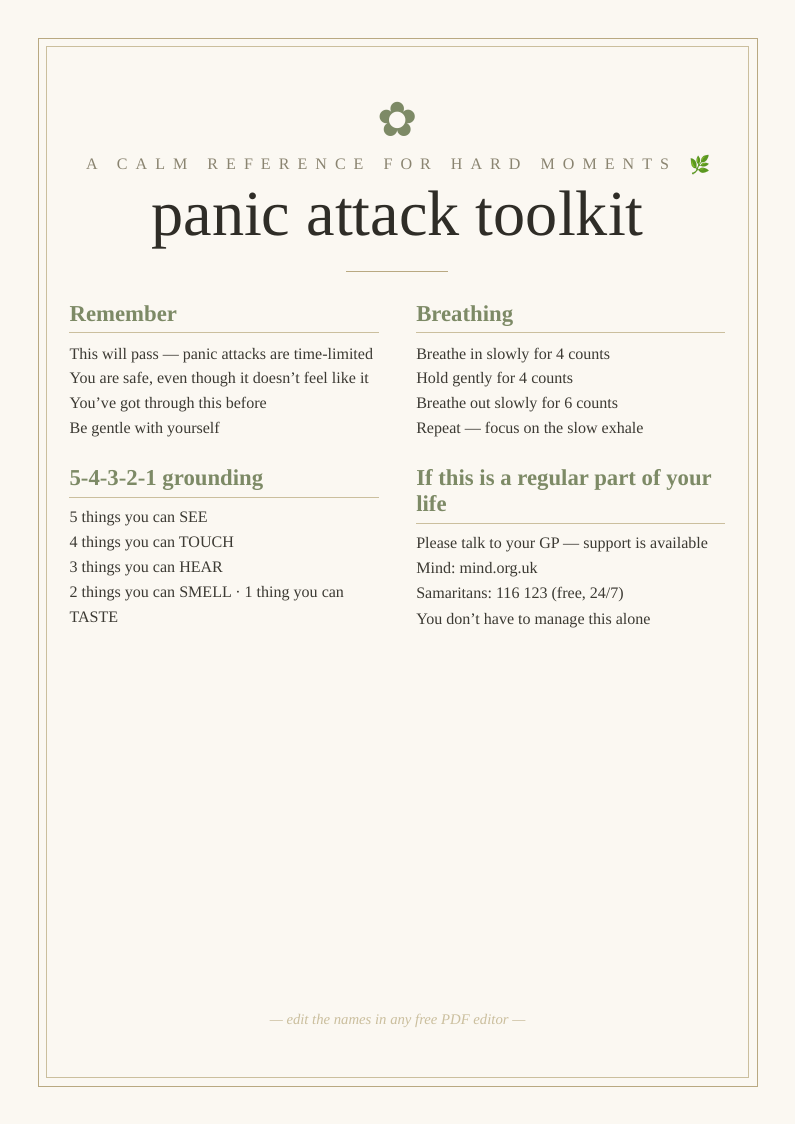
Several simple, widely-recommended techniques can help in the moment during a panic attack, and having them written down somewhere accessible can be reassuring because it's hard to think clearly in the moment itself. Slow breathing is one of the most commonly recommended approaches — breathing in slowly for a count of around four, holding gently, then breathing out slowly for a slightly longer count, with the focus on the slow exhale, which can help calm the body's stress response. Grounding techniques, like the '5-4-3-2-1' method (naming five things you can see, four you can touch, three you can hear, two you can smell, and one you can taste), can help bring attention back to the present moment and away from the intensity of the panic. It can also help simply to remind yourself, even if it doesn't feel true in the moment, that panic attacks are time-limited and will pass, and that you are safe, even though the physical sensations feel alarming. These are general, widely-shared coping techniques, not medical treatment, and what helps varies from person to person. If panic attacks are a regular or frequent part of your life, or significantly affecting your day-to-day wellbeing, it's really worth talking to your GP, who can discuss your symptoms properly and the range of support and treatment options available, including therapy approaches that are specifically effective for panic and anxiety. You don't have to manage this alone — organisations like Mind (mind.org.uk) offer further information and support, and the Samaritans (116 123, free, available 24/7) are there if you need to talk to someone at any time.
Is it really free?
Yes — no email, no sign-up.
Can I print it more than once?
Yes — print as many copies as you need.