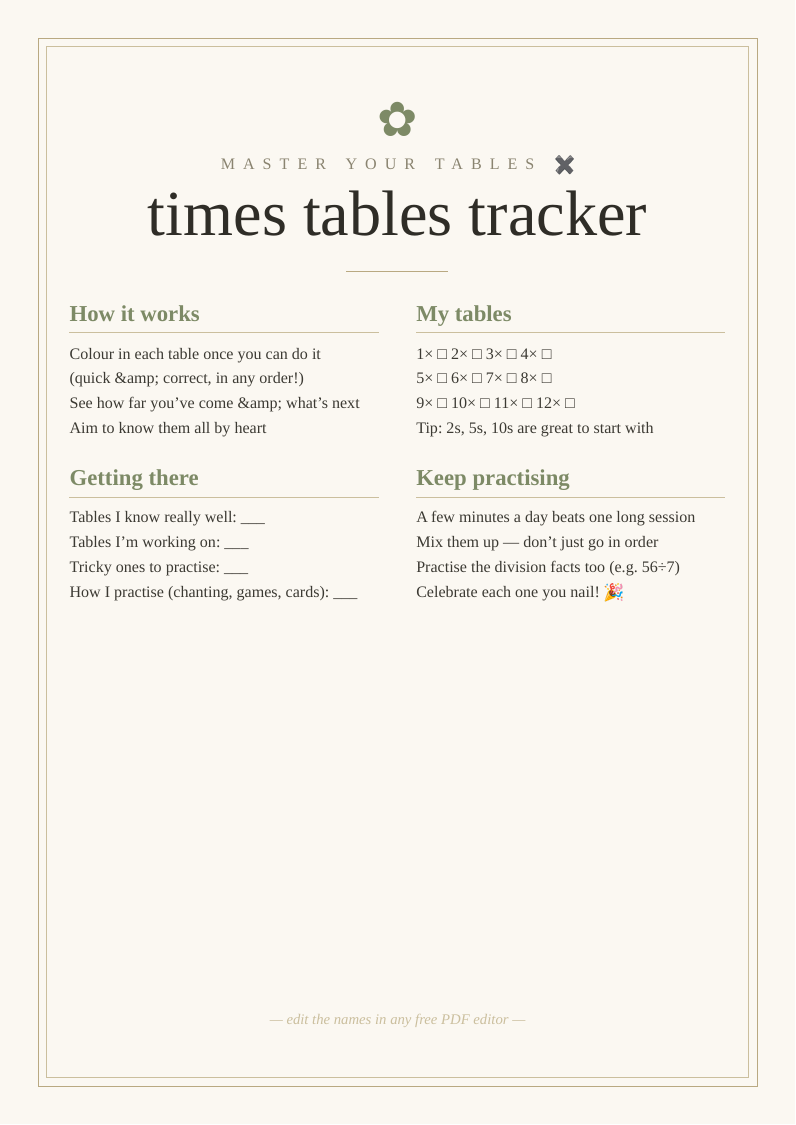
What you get
Designed to look bought, priced at nothing
Three print sizes
A2 and A3 for home printers, plus 18×24" for a print shop or easel.
Fully editable
Change the wording in any free PDF editor — no design software needed.
High-resolution
Crisp 300 DPI vector text that stays sharp at poster size.
How to use it
From download to display in three steps
- Personalise. Open the PDF in Canva, Acrobat online or Apple Preview and edit the text.
- Print. Heavyweight matte card at home for A3 and under; a print shop for 18×24".
- Display. Frame it or stand it on an easel at your .
Top picks compared
| Pick | What you'll want | Best for | |
|---|---|---|---|
| Top pick | A4 heavyweight matte card | Tables tracker | Check price → |
| Flashcards | Times tables flashcards multiplication children maths practice | Practise | Check price → |
| Maths book | Times tables practice book children KS2 multiplication UK | Learn tables | Check price → |
As an Amazon Associate we earn from qualifying purchases. Prices shown on Amazon at time of click.
Frequently asked questions
What’s the best way to learn times tables?
Learning times tables to the point of instant recall is a really important maths foundation (and in England, Year 4 children sit a Multiplication Tables Check), and a few approaches work far better than others. The key principles: practise little and often — a few minutes daily is far more effective than one long weekly slog, as it builds the memory through regular retrieval; and aim for quick, automatic recall in any order, not just chanting the table in sequence (a child who can only get to 7×8 by counting up from the start doesn't truly know it). A progress tracker helps motivation hugely by making the journey visible — colouring in each table as it's mastered gives a satisfying sense of progress and shows clearly what's left to conquer. Good tactics: start with the easier, pattern-based tables (2s, 5s, 10s) to build confidence, then tackle the rest, spending extra time on the trickier ones (6s, 7s, 8s tend to be hardest); mix them up rather than always practising in order; and practise the related division facts too (knowing 7×8=56 should also mean knowing 56÷7=8). Make it fun with games, songs, flashcards and apps rather than pure drill, and celebrate each table mastered. Consistent, varied, little-and-often practice with a clear sense of progress is the winning formula — for both teachers and parents helping at home.
Is it really free?
Yes — no email, no sign-up.
Can I print it more than once?
Yes — print as many copies as you need.