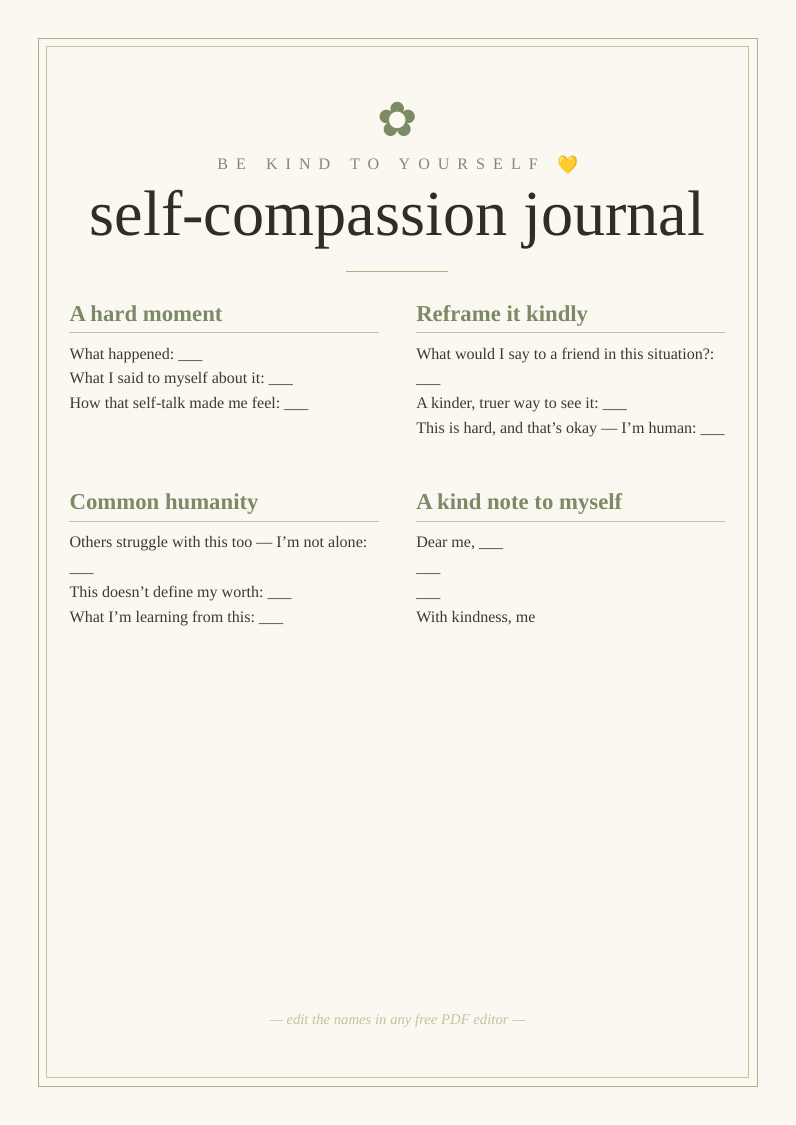
What you get
Designed to look bought, priced at nothing
Three print sizes
A2 and A3 for home printers, plus 18×24" for a print shop or easel.
Fully editable
Change the wording in any free PDF editor — no design software needed.
High-resolution
Crisp 300 DPI vector text that stays sharp at poster size.
How to use it
From download to display in three steps
- Personalise. Open the PDF in Canva, Acrobat online or Apple Preview and edit the text.
- Print. Heavyweight matte card at home for A3 and under; a print shop for 18×24".
- Display. Frame it or stand it on an easel at your .
Top picks compared
| Pick | What you'll want | Best for | |
|---|---|---|---|
| Top pick | A4 heavyweight matte card | Self-compassion journal | Check price → |
| Self-compassion book | Self compassion book Kristin Neff wellbeing | Learn more | Check price → |
| Journal | Wellbeing journal reflection prompts mental health | Journal it | Check price → |
As an Amazon Associate we earn from qualifying purchases. Prices shown on Amazon at time of click.
Frequently asked questions
What is self-compassion and why does it matter?
Self-compassion means treating yourself with the same kindness, understanding and support you'd naturally offer a good friend who was struggling — rather than the harsh self-criticism many people default to when they make a mistake, fall short of their own expectations, or go through a hard time. Research in this area (much of it associated with psychologist Kristin Neff) generally identifies three components: self-kindness (being gentle with yourself rather than harshly self-critical), common humanity (recognising that struggle, failure and imperfection are part of being human, not signs that something is uniquely wrong with you), and mindfulness (acknowledging difficult feelings without either suppressing them or being completely overwhelmed by them). This matters because self-criticism, while often intended to motivate improvement, tends to backfire — it's linked to increased anxiety, lower resilience, and can actually undermine motivation and performance rather than improving it, whereas self-compassion is associated with greater emotional resilience, wellbeing, and paradoxically often more, not less, motivation to grow and improve. A journal practice helps build self-compassion as a skill: when you notice harsh self-talk after a difficult moment, deliberately pausing to ask 'what would I say to a friend here?' and writing a kinder, truer reframe helps interrupt the automatic critical pattern over time. It's a practice, not a one-off fix — like any habit, it becomes more natural with repetition. If self-criticism is severe, persistent, or connected to low mood or anxiety that's affecting your daily life, it's worth talking to your GP or a therapist, as self-compassion practices work well alongside, not instead of, professional support where it's needed.
Is it really free?
Yes — no email, no sign-up.
Can I print it more than once?
Yes — print as many copies as you need.