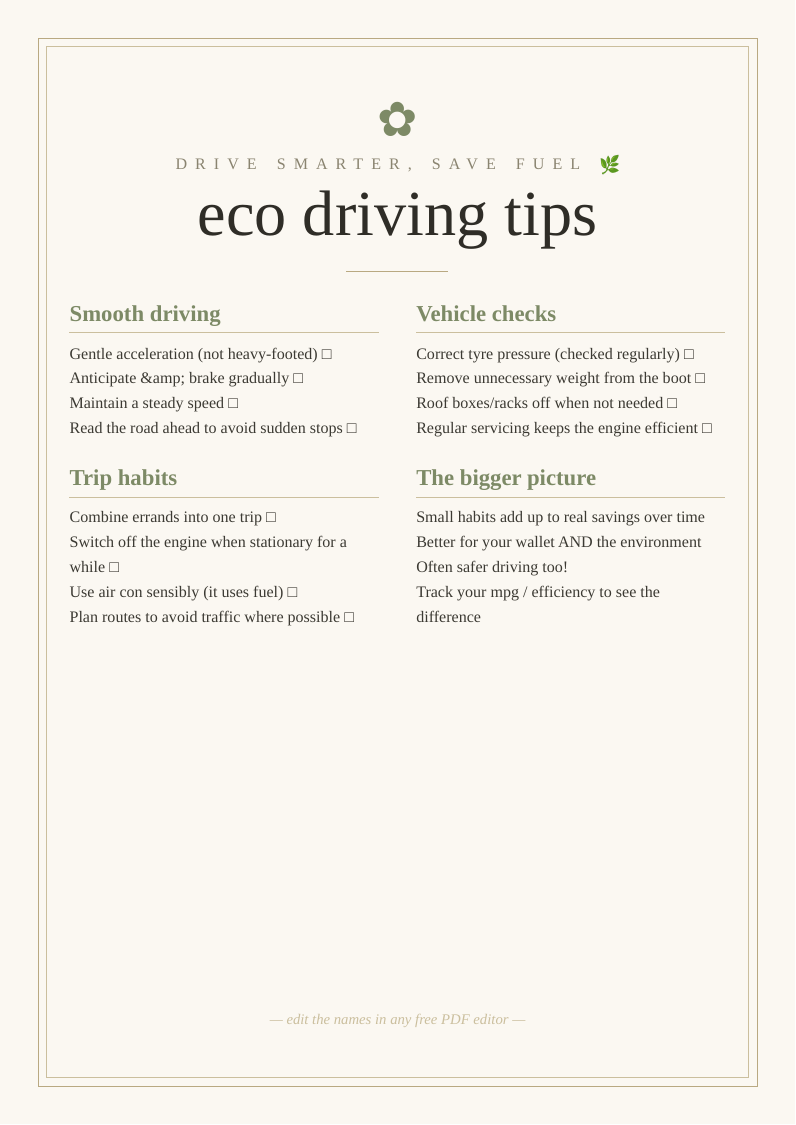
What you get
Designed to look bought, priced at nothing
Three print sizes
A2 and A3 for home printers, plus 18×24" for a print shop or easel.
Fully editable
Change the wording in any free PDF editor — no design software needed.
High-resolution
Crisp 300 DPI vector text that stays sharp at poster size.
How to use it
From download to display in three steps
- Personalise. Open the PDF in Canva, Acrobat online or Apple Preview and edit the text.
- Print. Heavyweight matte card at home for A3 and under; a print shop for 18×24".
- Display. Frame it or stand it on an easel at your .
Top picks compared
| Pick | What you'll want | Best for | |
|---|---|---|---|
| Top pick | A4 heavyweight matte card | Eco driving tips | Check price → |
| Tyre gauge | Tyre pressure gauge digital car accurate | Check pressure | Check price → |
| Car maintenance book | Car maintenance guide book UK fuel efficiency | Learn more | Check price → |
As an Amazon Associate we earn from qualifying purchases. Prices shown on Amazon at time of click.
Frequently asked questions
How can you save fuel through your driving style?
How you drive has a real impact on fuel consumption, often more than people realise, and the good news is that the habits which save fuel also tend to be smoother, calmer and safer driving — so there's little downside to adopting them. Smooth, anticipatory driving is the biggest factor: gentle acceleration rather than heavy-footed starts, reading the road ahead so you can brake gradually rather than suddenly, and maintaining a steady speed rather than constantly speeding up and slowing down, all reduce how hard your engine has to work. Harsh acceleration and braking burn noticeably more fuel than smooth, planned driving covering the same distance. Vehicle maintenance matters too: under-inflated tyres increase rolling resistance and fuel use, so checking tyre pressure regularly is a simple, free habit that helps; unnecessary weight in the boot and roof boxes or racks left on when not in use also create drag and extra load, both costing fuel. Regular servicing keeps the engine running efficiently, since a poorly maintained engine burns more fuel than it needs to. On the trip-planning side, combining several errands into one outing rather than multiple short trips (cold engines are less efficient) saves fuel, as does avoiding unnecessary idling — switching off the engine if you're going to be stationary for a while rather than letting it run. None of these individually make a huge difference, but together, consistently applied, they add up to meaningful savings over months and years, both for your wallet at the pump and for your car's wear and tear. As a bonus, smoother, more anticipatory driving is also generally safer driving.
Is it really free?
Yes — no email, no sign-up.
Can I print it more than once?
Yes — print as many copies as you need.