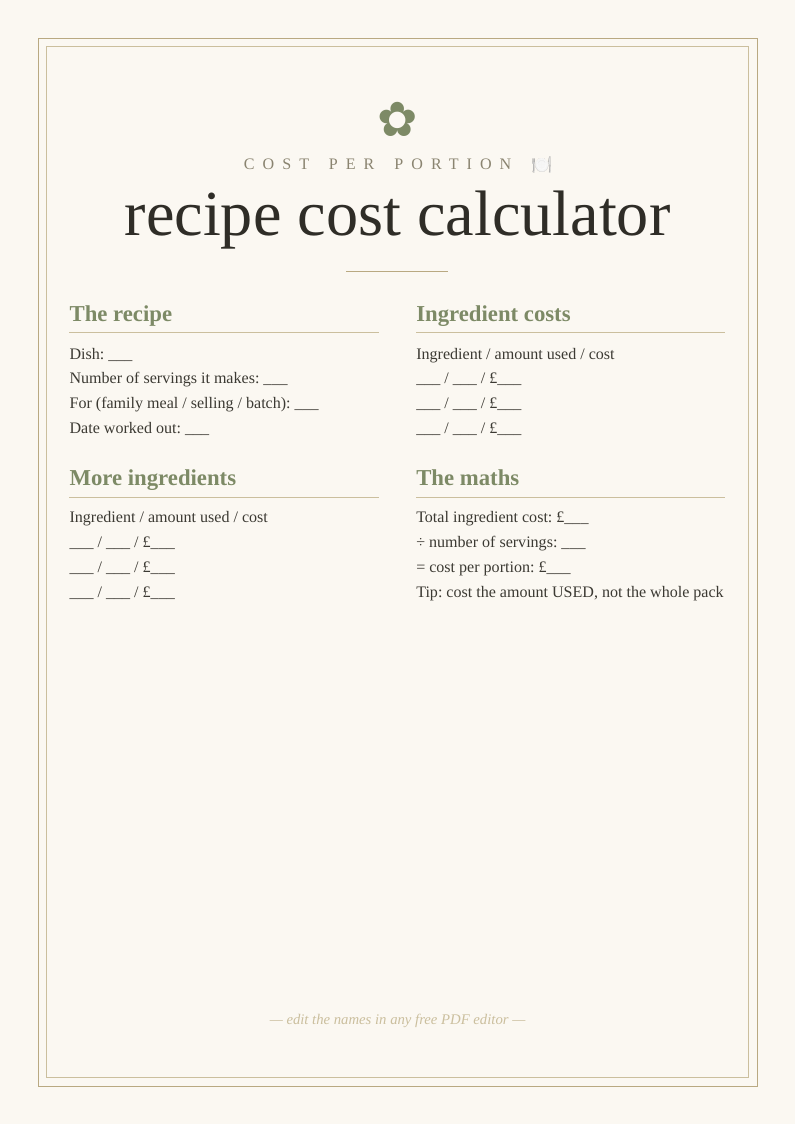
What you get
Designed to look bought, priced at nothing
Three print sizes
A2 and A3 for home printers, plus 18×24" for a print shop or easel.
Fully editable
Change the wording in any free PDF editor — no design software needed.
High-resolution
Crisp 300 DPI vector text that stays sharp at poster size.
How to use it
From download to display in three steps
- Personalise. Open the PDF in Canva, Acrobat online or Apple Preview and edit the text.
- Print. Heavyweight matte card at home for A3 and under; a print shop for 18×24".
- Display. Frame it or stand it on an easel at your .
Top picks compared
| Pick | What you'll want | Best for | |
|---|---|---|---|
| Top pick | A4 heavyweight matte card | Cost sheet | Check price → |
| Kitchen scale | Digital kitchen scale food weighing accurate grams cooking | Weigh it | Check price → |
| Budget cookbook | Budget cookbook cheap meals family money saving UK recipes | Save money | Check price → |
As an Amazon Associate we earn from qualifying purchases. Prices shown on Amazon at time of click.
Frequently asked questions
How do you work out the cost per portion of a recipe?
Working out a recipe's cost per portion is simple in principle: add up the cost of all the ingredients used, then divide by the number of servings the recipe makes. The key detail that trips people up is to cost the amount you actually use, not the price of the whole pack — so if a recipe uses 100g of cheese from a 250g block costing £2, you count 80p, not £2. Work through each ingredient this way (a kitchen scale helps for accuracy), total them, and divide by servings. This is genuinely useful for a few reasons: it shows you which meals are cheap and which are surprisingly pricey, helping you budget and plan economical meals; it proves how much batch cooking and cooking from scratch can save versus ready meals or takeaways; and if you sell food (at a market, say) it's essential for pricing properly so you cover costs and make a margin. You can do a rough version (estimating store-cupboard staples) or a precise one. Once you've costed your regular meals, you'll have a clear picture of your real food spending and where you can save. If you're selling food, remember to factor in more than ingredients — see our hobby-to-income guide.
Is it really free?
Yes — no email, no sign-up.
Can I print it more than once?
Yes — print as many copies as you need.