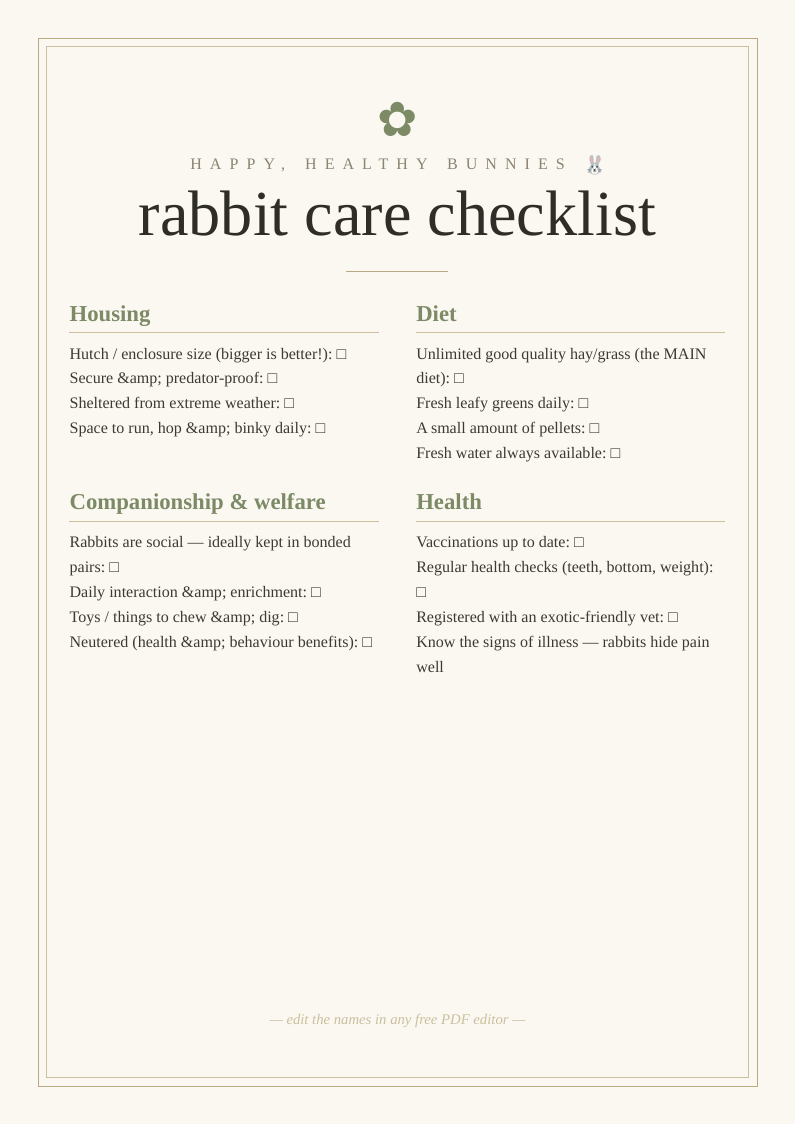
What you get
Designed to look bought, priced at nothing
Three print sizes
A2 and A3 for home printers, plus 18×24" for a print shop or easel.
Fully editable
Change the wording in any free PDF editor — no design software needed.
High-resolution
Crisp 300 DPI vector text that stays sharp at poster size.
How to use it
From download to display in three steps
- Personalise. Open the PDF in Canva, Acrobat online or Apple Preview and edit the text.
- Print. Heavyweight matte card at home for A3 and under; a print shop for 18×24".
- Display. Frame it or stand it on an easel at your .
Top picks compared
| Pick | What you'll want | Best for | |
|---|---|---|---|
| Top pick | A4 heavyweight matte card | Rabbit checklist | Check price → |
| Rabbit hutch | Large rabbit hutch run outdoor secure | House them well | Check price → |
| Rabbit hay | Rabbit hay timothy fresh large bag | Feed well | Check price → |
As an Amazon Associate we earn from qualifying purchases. Prices shown on Amazon at time of click.
Frequently asked questions
What do rabbits actually need to be happy and healthy?
Rabbits are often underestimated as 'easy' starter pets, but their welfare needs are genuinely specific and quite different from what many people assume, so it's worth understanding them properly. Housing needs to be much larger than traditional small hutches suggest — rabbits need enough space to take several hops in any direction and stand up fully on their hind legs, plus daily access to a secure run where they can properly exercise, run and binky (the joyful jump rabbits do when happy). Diet is one of the most commonly got-wrong areas: contrary to old advice, the vast majority of a rabbit's diet should be good quality hay or grass (available unlimited, all the time), as this is essential for their digestive health and continuously growing teeth, with fresh leafy greens daily and only a small amount of pellets — not the muesli-style mixes that used to be common, which can cause serious health problems through selective feeding. Companionship matters enormously: rabbits are highly social animals and, in most cases, are happiest living in neutered, bonded pairs rather than alone, alongside daily human interaction and enrichment like things to dig, chew and explore. On health, rabbits are prey animals that instinctively hide signs of pain or illness, so regular health checks (teeth, weight, their rear end for cleanliness, which matters for preventing flystrike) and a vet experienced with rabbits (an 'exotics' vet) are important, along with keeping vaccinations current. Getting these fundamentals right — space, correct diet, companionship and proper veterinary care — makes a huge difference to a rabbit's quality of life, and reflects how much rabbit welfare understanding has improved in recent years. The RSPCA and Rabbit Welfare Association offer detailed guidance if you're considering or already have rabbits.
Is it really free?
Yes — no email, no sign-up.
Can I print it more than once?
Yes — print as many copies as you need.