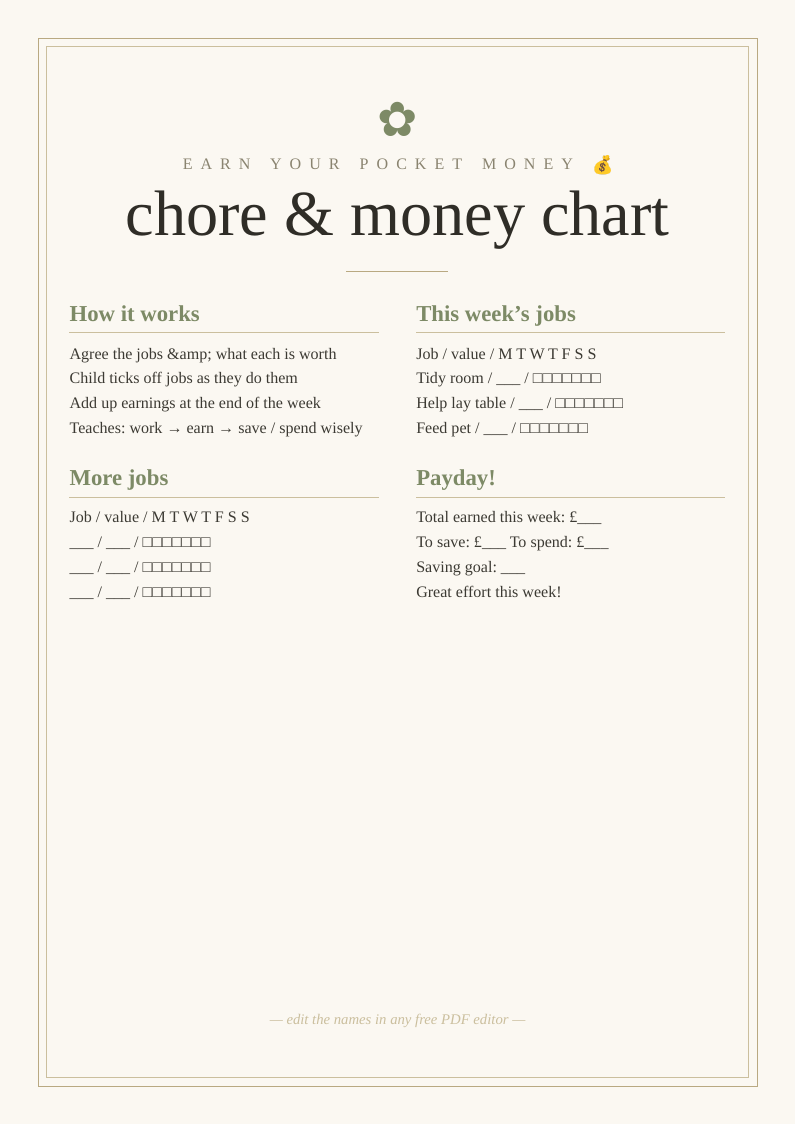
What you get
Designed to look bought, priced at nothing
Three print sizes
A2 and A3 for home printers, plus 18×24" for a print shop or easel.
Fully editable
Change the wording in any free PDF editor — no design software needed.
High-resolution
Crisp 300 DPI vector text that stays sharp at poster size.
How to use it
From download to display in three steps
- Personalise. Open the PDF in Canva, Acrobat online or Apple Preview and edit the text.
- Print. Heavyweight matte card at home for A3 and under; a print shop for 18×24".
- Display. Frame it or stand it on an easel at your .
Top picks compared
| Pick | What you'll want | Best for | |
|---|---|---|---|
| Top pick | A4 heavyweight matte card | Money chart | Check price → |
| Money box | Kids money box piggy bank save spend share jars children | Save it | Check price → |
| Reward stickers | Reward stickers children chart chore motivation pack | Reward | Check price → |
As an Amazon Associate we earn from qualifying purchases. Prices shown on Amazon at time of click.
Frequently asked questions
Should you pay children for chores?
Whether to link pocket money to chores is a common parenting question, and there's no single right answer — different approaches suit different families, and many use a blend. The case for linking them: tying some pocket money to jobs teaches the powerful real-world lesson that money is earned through work, gives children a sense of contribution, and creates natural opportunities to teach budgeting, saving and spending choices. The case for some separation: many parents feel certain everyday chores should simply be expected as part of being in a family (not paid), while pocket money is given separately or linked only to extra, bigger jobs — so children learn both that you contribute to your home for free AND that extra effort can be rewarded. A popular middle path is exactly that: some basic chores are just expected, while a chart of additional paid jobs lets children earn. Whatever you choose, a chart helps by making the expectations and earnings clear and visible, which motivates children and avoids arguments. It's also a great chance to introduce the save/spend/share idea — encouraging children to put some earnings aside for a goal teaches saving early. Keep amounts age-appropriate, be consistent, and use it as a gentle, practical money-and-responsibility lesson. There's no wrong choice — pick what fits your family's values.
Is it really free?
Yes — no email, no sign-up.
Can I print it more than once?
Yes — print as many copies as you need.