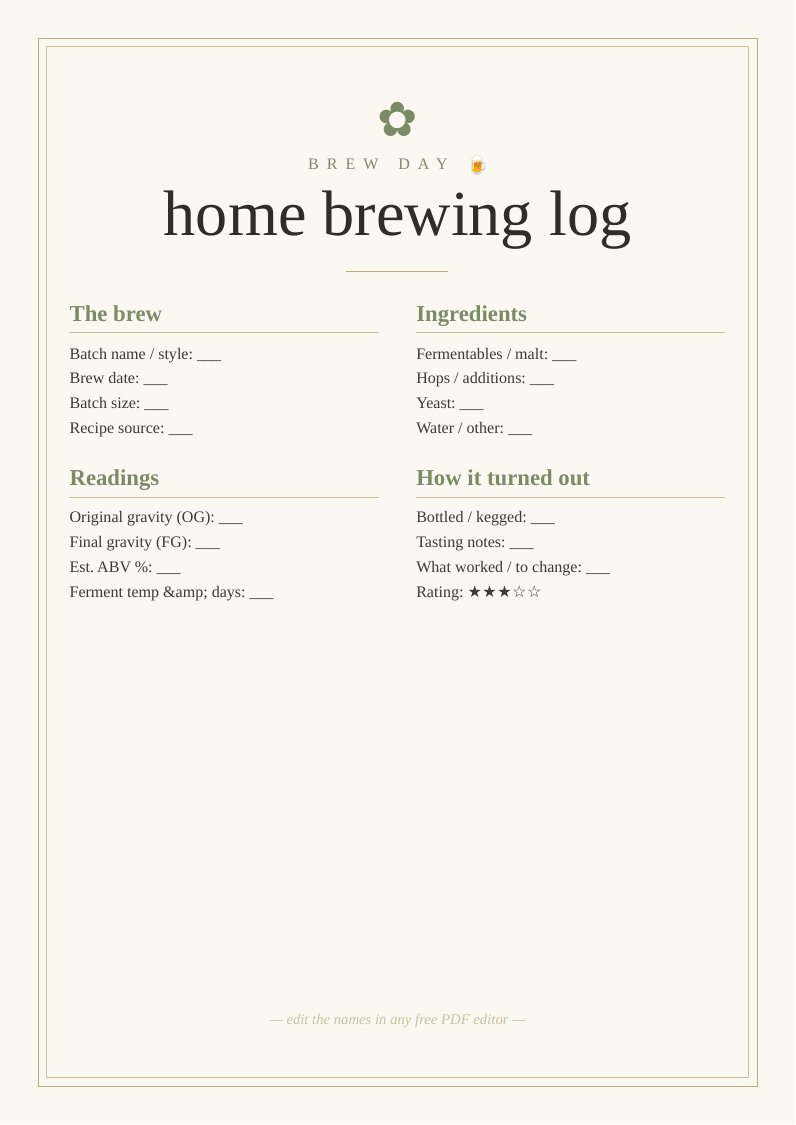
What you get
Designed to look bought, priced at nothing
Three print sizes
A2 and A3 for home printers, plus 18×24" for a print shop or easel.
Fully editable
Change the wording in any free PDF editor — no design software needed.
High-resolution
Crisp 300 DPI vector text that stays sharp at poster size.
How to use it
From download to display in three steps
- Personalise. Open the PDF in Canva, Acrobat online or Apple Preview and edit the text.
- Print. Heavyweight matte card at home for A3 and under; a print shop for 18×24".
- Display. Frame it or stand it on an easel at your .
Top picks compared
| Pick | What you'll want | Best for | |
|---|---|---|---|
| Top pick | A4 heavyweight matte card | Brew log | Check price → |
| Starter kit | Home brewing kit beer starter equipment beginners UK | Get brewing | Check price → |
| Hydrometer | Hydrometer home brewing gravity test kit beer wine | Measure ABV | Check price → |
As an Amazon Associate we earn from qualifying purchases. Prices shown on Amazon at time of click.
Frequently asked questions
Why keep a home brewing log?
Home brewing is part recipe, part science experiment — the same recipe can turn out differently depending on your ingredients, fermentation temperature, timings and technique — so a brew log is essential for anyone who wants to improve rather than just hope for the best. Recording each batch's recipe and ingredients, your gravity readings (original and final, which tell you how fermentation went and your alcohol content), your fermentation temperature and duration, and then tasting notes on the finished result, lets you do two crucial things: repeat the brews you love exactly, and troubleshoot the ones that didn't work by seeing what was different. Over several batches you learn how your kit and process behave and can adjust deliberately. It's also satisfying to look back on your brewing history and see your progress. A few notes: follow good sanitation and safety practice (cleanliness is the brewer's golden rule), and be aware of the UK rules on brewing for personal use versus selling. Whether you're doing beer, wine or cider, keeping notes is what turns lucky batches into reliable results.
Is it really free?
Yes — no email, no sign-up.
Can I print it more than once?
Yes — print as many copies as you need.