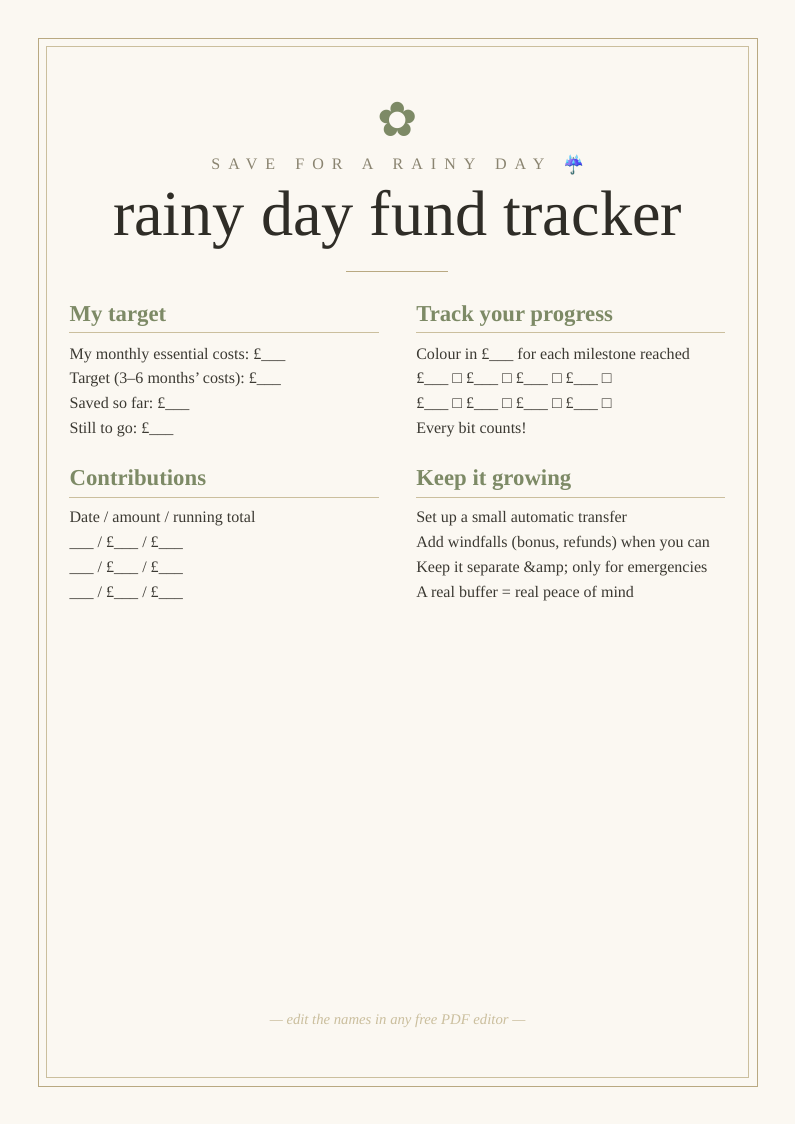
What you get
Designed to look bought, priced at nothing
Three print sizes
A2 and A3 for home printers, plus 18×24" for a print shop or easel.
Fully editable
Change the wording in any free PDF editor — no design software needed.
High-resolution
Crisp 300 DPI vector text that stays sharp at poster size.
How to use it
From download to display in three steps
- Personalise. Open the PDF in Canva, Acrobat online or Apple Preview and edit the text.
- Print. Heavyweight matte card at home for A3 and under; a print shop for 18×24".
- Display. Frame it or stand it on an easel at your .
Top picks compared
| Pick | What you'll want | Best for | |
|---|---|---|---|
| Top pick | A4 heavyweight matte card | Savings tracker | Check price → |
| Money book | Money A Users Guide Laura Whateley UK personal finance | Learn more | Check price → |
| Savings jar | Savings jar goal tracker money box visual progress | Save visually | Check price → |
As an Amazon Associate we earn from qualifying purchases. Prices shown on Amazon at time of click.
Frequently asked questions
How much should you keep in an emergency fund?
A common guideline for an emergency (or 'rainy day') fund is to aim for around three to six months' worth of essential living costs — rent or mortgage, bills, food, transport and other necessities — set aside in an easily accessible savings account. The exact target depends on your circumstances: those with less job security, irregular income, dependants, or a single income for the household may want to aim toward the higher end (or even beyond), while those with very stable income and a partner who also earns might be comfortable with less. The purpose of the fund is to cover genuine emergencies — job loss, an unexpected bill, a boiler breaking down, an emergency vet bill — without having to resort to high-interest debt or derailing your other financial plans. Building it doesn't need to happen all at once; setting up a small automatic monthly transfer, even a modest amount, builds the fund steadily over time, and adding occasional windfalls (a bonus, a tax refund, an unexpected bit of money) speeds it up further. It's worth keeping the fund in an easily accessible savings account (rather than locked away or invested) so it's there when you genuinely need it, and keeping it separate from your everyday spending account so it's not accidentally dipped into for non-emergencies. Watching the fund grow toward a target, even in modest contributions, is motivating and provides real psychological reassurance — financial experts consistently point to having an emergency fund as one of the foundations of financial resilience, often recommended as a priority even before other savings or investment goals. This is general information, not financial advice.
Is it really free?
Yes — no email, no sign-up.
Can I print it more than once?
Yes — print as many copies as you need.